

Leads not leave it too late! Understanding Key Lead Corrosion.
Corrosion and Expansion of Lead Weights in Piano Keys
What are piano key leads?
Lead weights, commonly referred to as key leads, are small pieces of lead embedded into the wooden keys of a piano. Their purpose is to balance the weight of the hammer and action mechanism and to give the keys the correct touch weight and return characteristics. Without these weights, many piano keys would be too light and would not return to their correct position efficiently.
Lead has traditionally been used because it is exceptionally dense, relatively soft, inexpensive and, under normal atmospheric conditions, comparatively resistant to corrosion. However, this resistance does not mean that lead is immune to corrosion. Lead can react with moisture and, particularly, with acidic pollutants and organic acids[1].
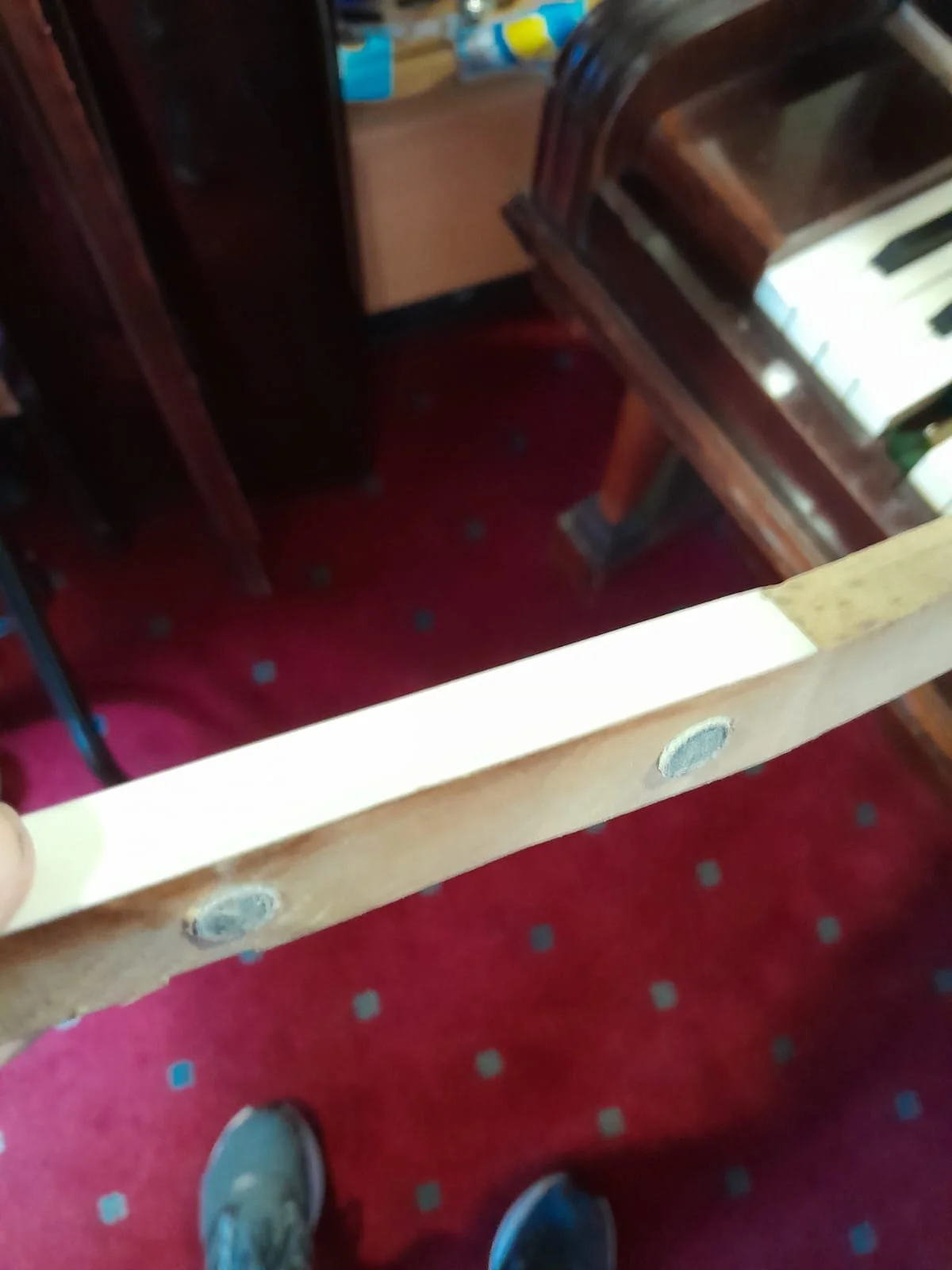
Oxidised key leads causing expansion.
Why does corrosion occur?
Renowned Piano Technician and author of “Pianos Inside Out” [2] Mario Igrec writes:
“Humidity is not the only factor that promotes corrosion of metal parts. Woods, glues, and finishing materials in pianos release acidic gases that attack all metal parts from strings, tuning pins, springs, action centers, key pins, even key leads.” [3].
These compounds can react with metal components inside the instrument. Lead is particularly susceptible to attack by organic acids such as acetic and formic acid, especially when moisture is also present[4].
This is why corrosion can occur even in a piano that has not necessarily been exposed to obviously excessive humidity. Humidity acts as an important accelerator because a thin film of moisture allows atmospheric pollutants and acidic compounds to interact more readily with the metal.
It is also worth making a distinction between oxidation and corrosion. Oxidation is one part of the corrosion process, but the white or grey material found on deteriorated piano leads is not simply "rust" in the same sense as iron rust. Scientific examination of deteriorated piano lead weights has identified compounds including lead formates, lead acetates and hydrocerussite, a basic lead carbonate[5].
What happens to the lead?
As corrosion progresses, the original metallic lead is gradually converted into corrosion products. Instead of remaining as a compact piece of metal, the surface develops a powdery or crystalline layer.
This is particularly significant with lead because some of these corrosion products occupy considerably more volume than the original metallic material. The result is that the lead weight can progressively swell or expand within the hole in the wooden key.
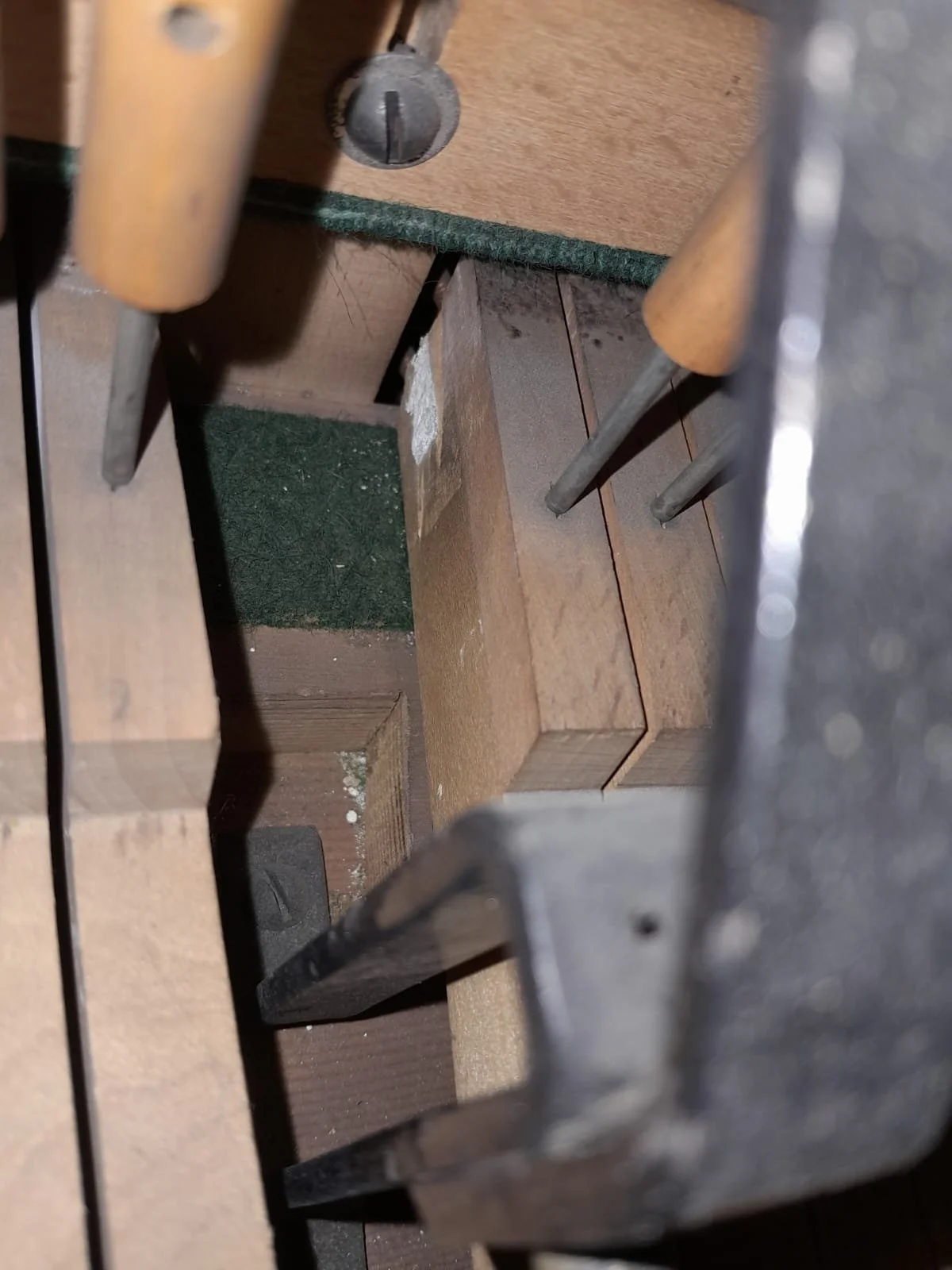
Example of powdery / crystalline layer forming on key lead as part of the corrosion process.
Active corrosion of lead is commonly recognised by a loose, white powdery deposit on its surface. Organic acids are a particularly important cause of this type of active corrosion[6].
The problem is made worse by the fact that the lead weight is normally installed tightly within a hole drilled into the key. The surrounding wood provides very little room for the expanding corrosion products to move.
How does the expanding lead damage the piano key?
The expanding lead effectively acts like a wedge inside the wooden key.
As the corrosion products increase in volume, pressure is exerted against the surrounding key wood. Initially this may produce a slight bulge in the side of the key. As expansion continues, the wood can begin to split along the grain or around the lead cavity.
As Mario Igrec says, “corroded leads can expand so much that they split the keys and block the entire keyboard”.
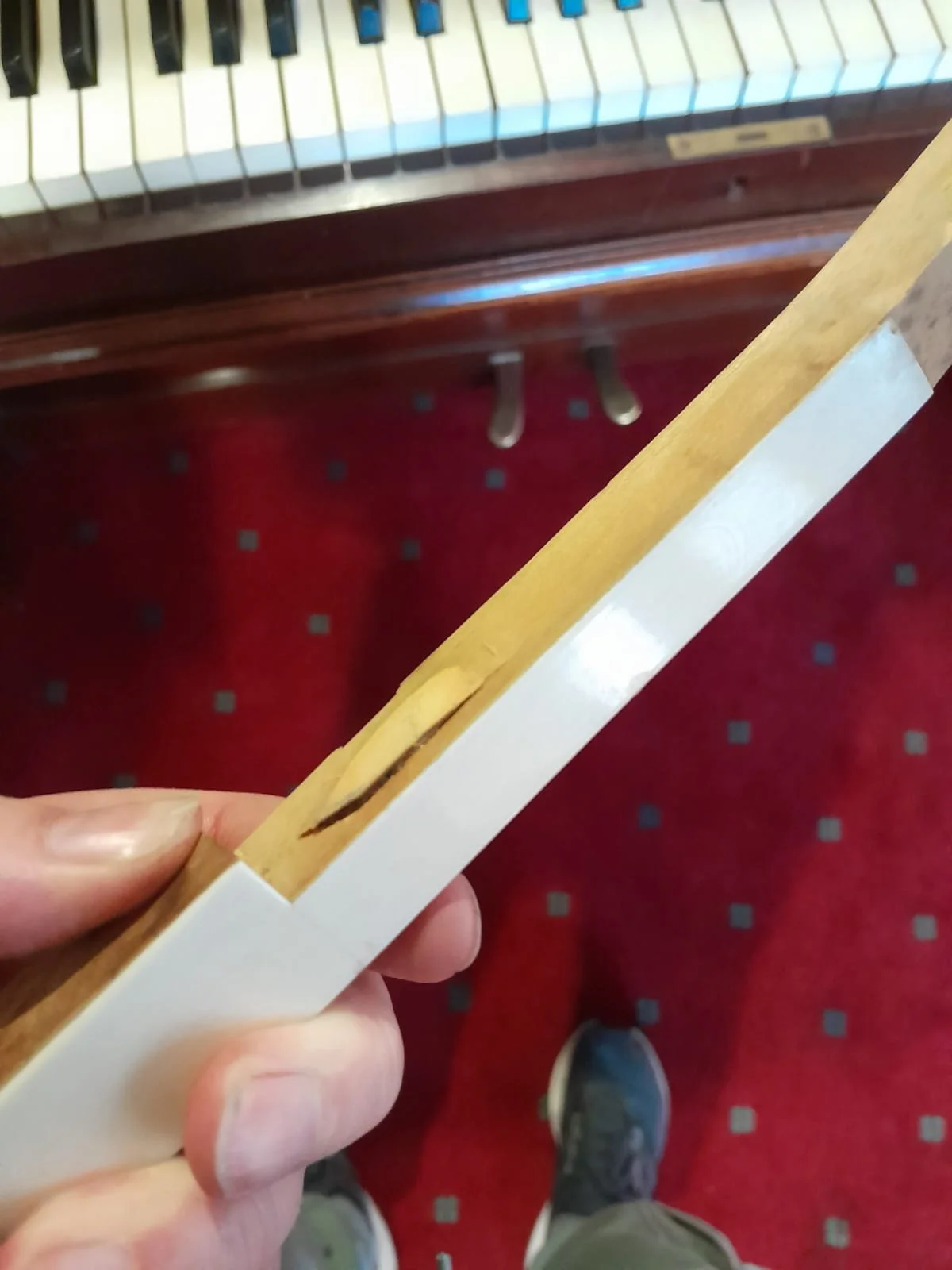
Damage to the wood of the key due to lead expansion!
The damage can progress through several stages:
The side of the key may begin to bulge around the lead.
The key may become wider and begin rubbing against its neighbouring keys.
Cracks can develop in the wooden key.
The keytop or ivory may become loose or distorted as the wood beneath it is forced apart.
The key may become difficult or impossible to regulate correctly.
Eventually, several adjacent keys may interfere with one another and the keyboard can begin to bind.
In severe cases, the expanding leads can split numerous keys and effectively make a large section of the keyboard unplayable.
Reports from piano technicians document cases in which expanding lead weights have caused keys to split, keys to rub against one another and keyboards to become effectively locked[7].
This is not simply a cosmetic problem. Once the wood has been forced apart, the geometry of the key has changed. The key may no longer sit correctly on its balance and front pins, and the action can no longer be regulated accurately. Continued attempts to force or play severely affected keys can cause further mechanical and structural damage.
How long does the process take?
There is no fixed timetable for lead corrosion or expansion. It depends on the particular piano and its environment.
The rate can be influenced by:
relative humidity and fluctuations in humidity;
temperature;
the concentration of acetic and formic acids within the piano;
the type and age of the wood used in the keyboard;
glues, finishes and other materials used in the instrument;
the composition of the lead or lead alloy;
ventilation and the extent to which the piano is enclosed;
the history of the piano and the environment in which it has been kept.
Laboratory studies have demonstrated that exposure of piano lead weights to acetic and formic acid vapours produces corrosion and hydrocerussite formation over time, while conservation research confirms that organic acids can make the corrosion of lead particularly active[8].
In real pianos, however, the process is normally a long-term deterioration rather than an event that occurs over a predictable number of days or months. Piano restoration experience has reported significant swelling in instruments around 60–100 years old, but this should not be interpreted as a guaranteed lifespan for lead weights. Some pianos develop the problem considerably earlier, while others may show little or no significant expansion despite being much older[9].
The important point is that corrosion can remain relatively inconspicuous for many years and then become increasingly destructive once sufficient corrosion product has accumulated. Once a lead weight has begun to expand and exert pressure on the surrounding wood, the damage should be regarded as an active structural problem rather than something that will simply stabilise on its own.
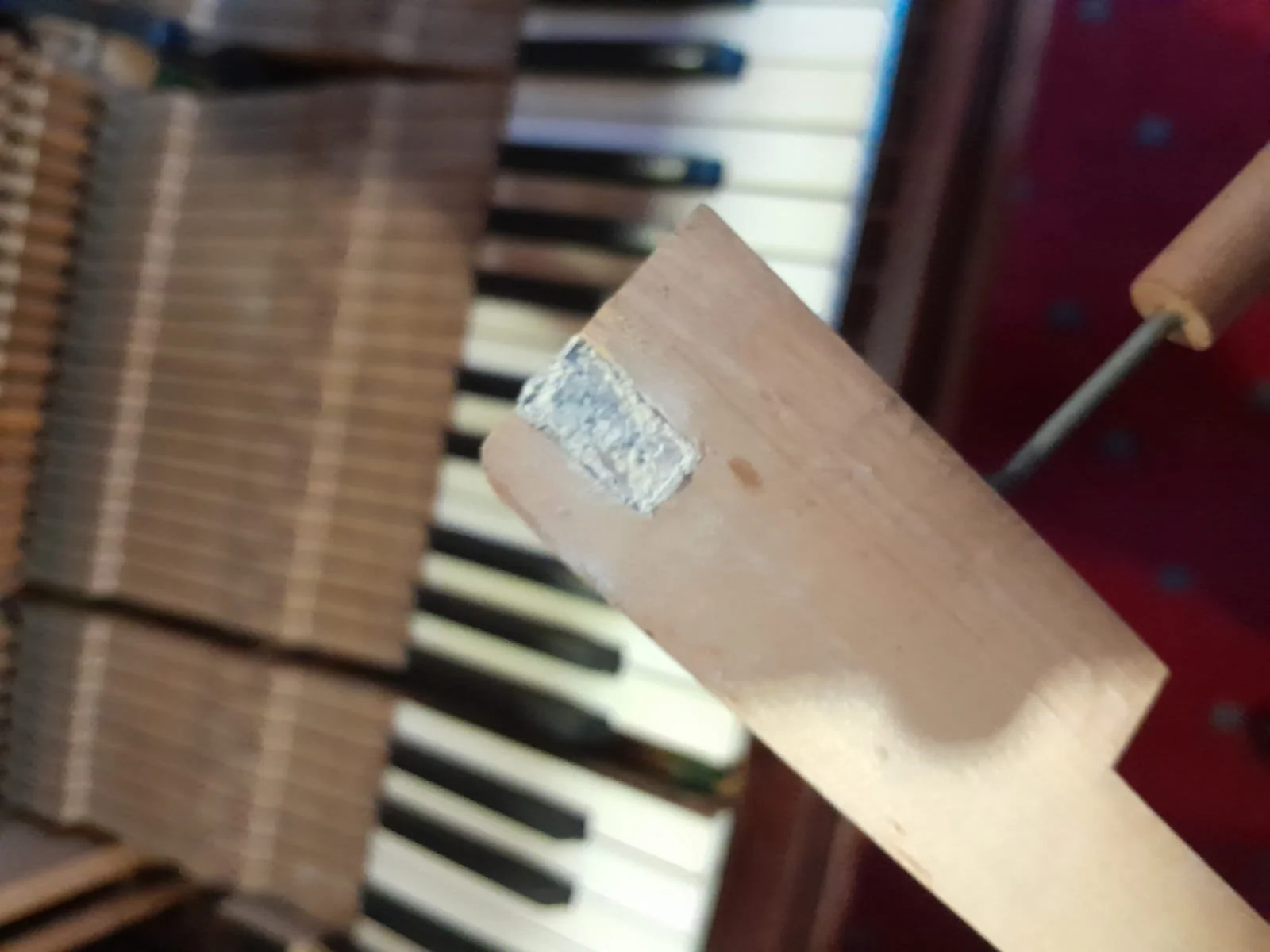
When key lead corrosion is identified it is important to discuss options with your piano technician. Don’t wait for it to cause your piano irreparable damage!
Why replacement is recommended
Corroded and expanding key leads should normally be removed and replaced, rather than simply left in place or cosmetically covered.
Removing the affected lead eliminates the source of the mechanical pressure and allows the wooden key to be assessed for cracking or other damage. Depending on the extent of the deterioration, the key may require repair or replacement before new weights are installed.
It is particularly important not to force keys that are already binding because of suspected expanding leads. Forcing the keys can increase pressure on the cracks and can cause further splitting of the wood, damage to keytops or additional damage to the action.
Lead itself is also a toxic material. Corroded lead should therefore be handled carefully, avoiding the creation or inhalation of dust, and significant lead-weight removal is best undertaken by an appropriately equipped piano technician or restorer[10].
Top Tips for Preventing Key Lead Expansion
Key lead expansion can affect the movement and responsiveness of your piano keys. Fortunately, there are several simple steps you can take to help reduce the risk and catch any problems early.
Keep your piano well ventilated
As Mario Igrec suggests; good airflow is one of the best ways to help prevent lead corrosion. Keep the fallboard open whenever possible, or at least during the day. When playing a grand piano, open the front lid; on an upright, open the top lid from time to time to allow air to circulate[12].Keep humidity under control
Avoid placing your piano in a damp or excessively humid environment. Use a basic hygrometer to monitor the room and aim for 45–55% relative humidity (RH) at a comfortable room temperature. If humidity regularly falls outside this range, consider a combined humidifier/dehumidifier system or speak to your piano technician about a Piano Life Saver system.Have your piano regularly tuned and serviced
Regular professional servicing helps ensure that any signs of key lead expansion or corrosion are identified early. Your technician can assess the condition of the keys and action and recommend appropriate measures before the problem becomes more serious.Don't ignore changes in key movement
If keys begin to feel sluggish, stick, or fail to return smoothly after being played, have your piano checked by a qualified technician. These can be early signs that attention is needed.
A little preventative care can go a long way. Keeping your piano well ventilated, maintaining stable humidity and arranging regular servicing will help protect its action and keep the keys performing at their best.
Summary
Corrosion of piano key leads is a chemical deterioration process in which the metallic lead reacts with moisture, oxygen, carbon dioxide and, particularly, acidic compounds such as acetic and formic acid. These acids can be released by materials within the piano, including wood, glues and finishes. Environmental conditions with high moisture can greatly accelerate the process[11].
As the metallic lead is converted into corrosion products, the resulting material can occupy substantially more volume than the original lead. Because the weight is confined within a closely fitted hole in the wooden key, this expansion places increasing pressure on the surrounding wood. The result can be bulging, cracking and splitting of the keys, followed by interference between adjacent keys and, in severe cases, the loss of normal playability across a substantial part of the keyboard.
Once evidence of expanding or actively corroding key leads is found, early replacement is advisable.
[1] Wikipedia — “Lead.”
[2] Pianos Inside Out, Mario Igrec
[3] Pianos Inside Out, Mario Igrec
[4] Ricciardi et al. (2023) — “Insight on the deterioration of cultural objects: a multi-analytical approach to characterize degradation products of lead weights from a Steinway & Sons piano.”
[5] Ricciardi et al. (2023)
[6] Canadian Conservation Institute — “Control of Pollutants in Museums and Archives – Technical Bulletin 37,” by Jean Tétreault.
[7] Piano Technicians Guild (Pianotech) — “key lead expansion.”
[8] Ricciardi et al. (2023)
[9] Piano Magic — “Piano Restoration, Replacing piano key leads.”
[10] Wikipedia — “Lead.”
[11] Ricciardi et al. (2023)
[12] Pianos Inside Out, Mario Igrec
Sources
Technical and scientific sources
Ricciardi et al. (2023) — “Insight on the deterioration of cultural objects: a multi-analytical approach to characterize degradation products of lead weights from a Steinway & Sons piano.”
PubMed — full article recordCanadian Conservation Institute — “Control of Pollutants in Museums and Archives – Technical Bulletin 37,” by Jean Tétreault.
Canadian Conservation Institute — Technical Bulletin 37Canadian Conservation Institute — “Recognizing Active Corrosion.”
Canadian Conservation Institute — Recognizing Active CorrosionCanadian Conservation Institute — “Storage of Metals.”
Canadian Conservation Institute — Storage of MetalsCanadian Conservation Institute — “Lead in Museum Collections and Heritage Buildings.”
Canadian Conservation Institute — Lead in Museum Collections and Heritage Buildings
Piano-specific sources
Piano Magic — “Piano Restoration, Replacing piano key leads.”
Piano Magic — Replacing Piano Key LeadsPiano Technicians Guild (Pianotech) — “key lead expansion.”
Piano Technicians Guild — Key Lead Expansion discussionPiano Technicians Guild (Pianotech) — “Growing Leads.”
Piano Technicians Guild — Growing Leads discussionPianos Inside Out. (n.d.). Pianos Inside Out. Mario Igrec. Available at: www.pianosinsideout.com
General chemistry/background
Wikipedia — “Lead.”
Wikipedia — Lead